


 Español
 Portugues
 Français
 Italiano
 Nederlands
 Polski
 Română
 lietuvių
 Hrvatski
Core Barrel
A core barrel is a key tool used in drilling operations to recover intact cylindrical samples of rock, soil, or concrete, known as cores. These samples are essential for geological, geotechnical, mineral exploration, and engineering investigations, because they preserve the in‑situ structure, layering, and physical properties of the subsurface materials.Structurally, a core barrel is a tubular assembly that fits inside a drill string. At its lower end it holds a cutting bit, which may be made of tungsten carbide, polycrystalline diamond, or impregnated diamond segments, depending on the hardness and abrasiveness of the formation. As the drill rotates and advances, the bit cuts an annular ring, allowing an inner column of material to enter and remain inside the barrel as a core.Core barrels can be single‑tube, double‑tube, or triple‑tube. A single‑tube barrel is a simple design where the core is retained directly within the outer tube; it is more robust but offers less protection to fractured or soft core. Double‑tube designs introduce an inner tube that remains stationary relative to the rotating outer tube, reducing core disturbance and improving recovery, especially in broken ground. Triple‑tube barrels add a removable liner inside the inner tube, providing maximum core preservation and better handling in highly fractured, weathered, or very soft formations.There are also surface and wireline core barrel systems. In conventional surface systems, the entire drill string must be pulled to retrieve the core, which can be time‑consuming at depth. Wireline systems allow the inner tube containing the core to be lifted to the surface using an overshot tool lowered on a wire or cable, leaving the outer barrel and drill string in place. This significantly improves efficiency and safety in deep or challenging boreholes.Core barrels are designed for a range of core diameters, often identified by standard size codes. Larger diameters yield more material for testing and better representation of structural features, while smaller diameters reduce drilling costs and required rig capacity. The choice depends on project objectives, expected ground conditions, and required laboratory tests.Key performance factors include core recovery, core quality, bit life, and the ability to function under challenging conditions such as high deviation, high temperature, or highly abrasive rock. Proper selection and maintenance of the barrel components, including bearings, inner tube, landing ring, and seals, are critical to avoid jamming, core loss, or damage.In practice, core barrels support a wide range of activities: mineral resource estimation, slope stability analysis, foundation design, hydrogeological assessment, and quality control for tunneling and large infrastructure. By enabling the extraction of continuous, well‑preserved cores, they provide a direct, verifiable record of subsurface conditions that cannot be matched by indirect geophysical methods alone.
Products
Category:
-
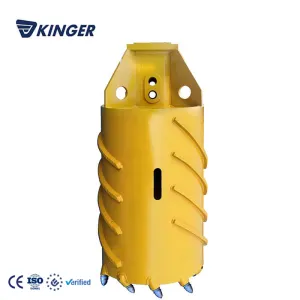
Core Barrel
Category: Construction machineryBrowse number: 494Number:Release time: 2026-02-27 16:55:14Categories: Construction machinery
News
Category:
-
[blog]Heavy Duty Other Machinery Best Wholesale Manufacturers and...
2026-04-10 11:27:29
Case
Category:
No search results found!
Video
Category:
No search results found!
Download
Category:
No search results found!
Job
Category:
No search results found!
Featured Products
No search results found!



 WhatsApp
 Phone
Phone